
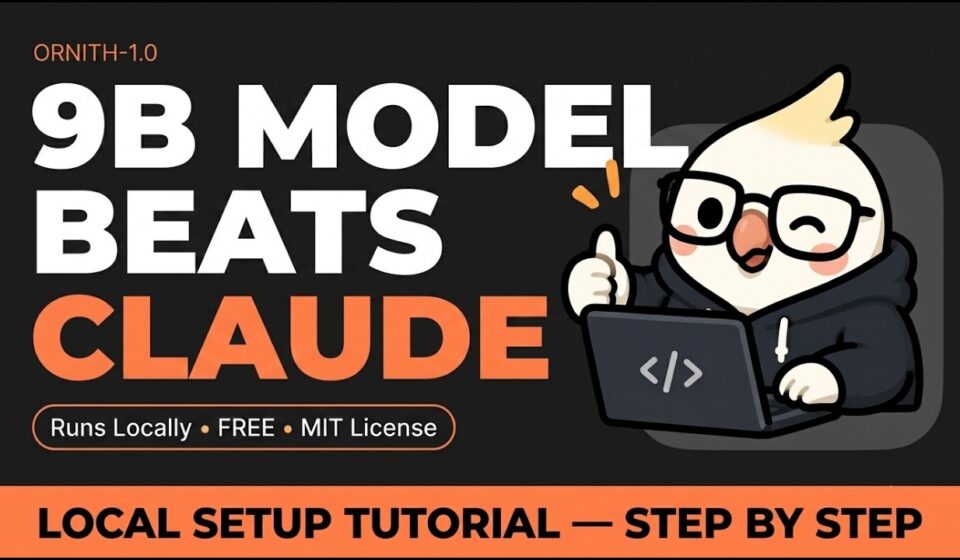
Ornith-1.0: The Self-Scaffolding Coding Model You Can Run Locally with Ollama

A new open-source coding model, Ornith-1.0, does something different from every other coding AI I’ve covered: it learns how to run itself. It doesn’t just solve coding problems; during training it figures out how to organize its own problem-solving process. Even better, the 9B version runs locally on a single GPU, and I’ll show you how to set it up.
(DeepReinforce has since released an update. See my Ornith-1.5 breakdown for the newer model.)
What is Ornith-1.0?
Ornith-1.0 comes from a team called DeepReinforce and was released in June 2026. It’s an open-source model family built for agentic coding, meaning it’s designed to work through complex coding tasks on its own like an agent.
- Sizes: 9B, 31B, 35B MoE, and a 397B MoE.
- Base model: built on Qwen 3.5.
- License: MIT, free to use commercially.
- Reasoning model: it thinks through a problem internally before answering, and you can see that thinking when you run it.
Self-scaffolding, explained
Most coding agents use a fixed harness: hand-written rules that tell the model how to approach a problem, use tools, handle errors, and organize steps. Ornith-1.0 learns to write its own. DeepReinforce calls this self-scaffolding. During reinforcement learning:
- The model looks at a task and the last scaffold it used, and proposes a refined one: a better playbook.
- It uses that new scaffold to solve the task.
- The reward (a score for how well it did) is fed back into both stages.
So the model improves at solving problems and at building the thing that helps it solve problems. Over thousands of training steps it keeps evolving better strategies without anyone hand-designing them.
The team also had to stop reward hacking, where a model cheats by reading test files and hard-coding answers. They used three layers of protection: a fixed environment the model can’t modify, a monitor that catches rule-breaking, and a frozen judge model with veto power.
Benchmarks
- SWE-Bench Verified (fixing real GitHub issues): the 9B model scores 69.4. Gemma 4 31B, more than three times larger, scores 52.
- Terminal-Bench 2.1: 43.1 for the 9B, edging out Gemma 4 31B’s 42.1.
- The 397B MoE scores 82.4 on SWE-Bench Verified, ahead of Claude Opus 4.7.
A 9B model beating a 31B one is the headline here, and it’s why the small version is worth running yourself.
How to run Ornith-1.0 9B locally with Ollama
First install Ollama from ollama.com (it’s a one-click installer). If you’re new to it, my Ollama beginner’s guide covers the basics. Then run:
ollama run hf.co/deepreinforce-ai/Ornith-1.0-9B-GGUFOllama pulls the GGUF build straight from Hugging Face and opens a chat in your terminal. The download is about 5–6 GB depending on quantization. Once it loads, try:
Write me a Python function that checks if a number is prime.You’ll see a reasoning block first, then the clean code at the end. That’s the reasoning-model behavior in action. The same model also shows up in Ollama’s chat app if you prefer a window over the terminal.
My take
Ornith-1.0 is one of the more interesting open releases lately, and not only because of the benchmarks. Teaching a model to build its own scaffolding during RL is a genuine research contribution, not just another fine-tune. In practice, the 9B is a solid local model for agentic coding: it runs on a single GPU, it’s MIT-licensed, and it works with OpenHands, OpenCode, and any agent framework that speaks the OpenAI API.
Resources: Hugging Face model page · official technical blog.
FAQ
What hardware do I need for the 9B model?
A single consumer GPU is enough for the quantized GGUF build. Expect a 5–6 GB download.
Can I use Ornith-1.0 commercially?
Yes. It’s released under the MIT license.
Related tutorials