Skip to content
-
Subscribe to our newsletter & never miss our best posts. Subscribe Now!
AI Brainbox logo AI Brainbox logo AI BrainBox

AI Tools | Automation | Workflows

AI Brainbox logo AI Brainbox logo AI BrainBox

AI Tools | Automation | Workflows

  • Home
  • Tutorials
  • About
  • Contact
  • Privacy Policy
  • Home
  • Tutorials
  • About
  • Contact
  • Privacy Policy
Close

Search

Trending Now:
Free AI Voice Generator Claude code for free Free AI tools Local AI models
  • FaceBook
  • X
  • LinkedIn
  • Instagram
  • YouTube
Subscribe
AI Brainbox logo AI Brainbox logo AI BrainBox

AI Tools | Automation | Workflows

AI Brainbox logo AI Brainbox logo AI BrainBox

AI Tools | Automation | Workflows

  • Home
  • Tutorials
  • About
  • Contact
  • Privacy Policy
  • Home
  • Tutorials
  • About
  • Contact
  • Privacy Policy
Close

Search

Trending Now:
Free AI Voice Generator Claude code for free Free AI tools Local AI models
  • FaceBook
  • X
  • LinkedIn
  • Instagram
  • YouTube
Subscribe
Home/AI Models/Ornith-1.0: The Self-Scaffolding Coding Model You Can Run Locally with Ollama
Ornith-1.0: The Self-Scaffolding Coding Model You Can Run Locally with Ollama
AI ModelsLocal AIOpen Source AI

Ornith-1.0: The Self-Scaffolding Coding Model You Can Run Locally with Ollama

By Umair Alam
November 21, 2026 3 Min Read
0

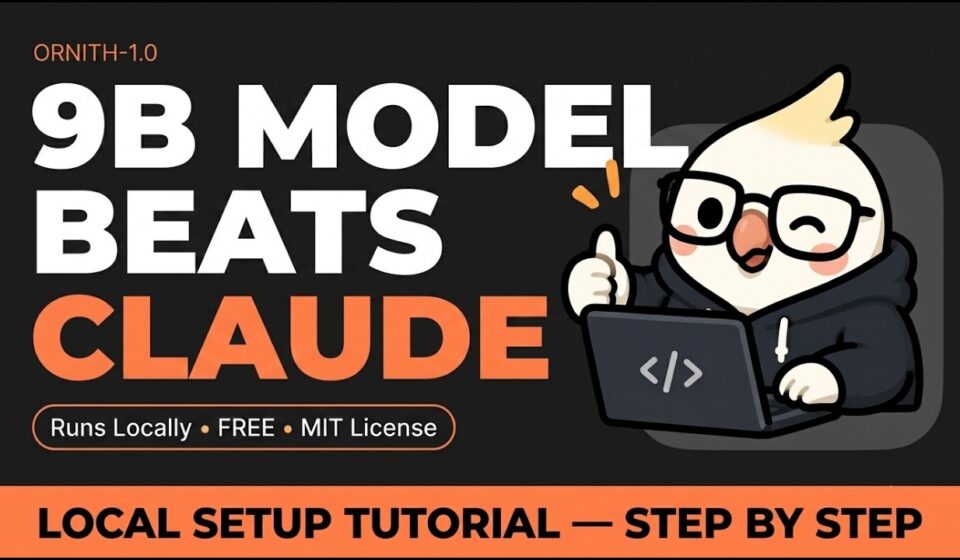
A new open-source coding model, Ornith-1.0, does something different from every other coding AI I’ve covered: it learns how to run itself. It doesn’t just solve coding problems; during training it figures out how to organize its own problem-solving process. Even better, the 9B version runs locally on a single GPU, and I’ll show you how to set it up.

(DeepReinforce has since released an update. See my Ornith-1.5 breakdown for the newer model.)

What is Ornith-1.0?

Ornith-1.0 comes from a team called DeepReinforce and was released in June 2026. It’s an open-source model family built for agentic coding, meaning it’s designed to work through complex coding tasks on its own like an agent.

  • Sizes: 9B, 31B, 35B MoE, and a 397B MoE.
  • Base model: built on Qwen 3.5.
  • License: MIT, free to use commercially.
  • Reasoning model: it thinks through a problem internally before answering, and you can see that thinking when you run it.

Self-scaffolding, explained

Most coding agents use a fixed harness: hand-written rules that tell the model how to approach a problem, use tools, handle errors, and organize steps. Ornith-1.0 learns to write its own. DeepReinforce calls this self-scaffolding. During reinforcement learning:

  1. The model looks at a task and the last scaffold it used, and proposes a refined one: a better playbook.
  2. It uses that new scaffold to solve the task.
  3. The reward (a score for how well it did) is fed back into both stages.

So the model improves at solving problems and at building the thing that helps it solve problems. Over thousands of training steps it keeps evolving better strategies without anyone hand-designing them.

The team also had to stop reward hacking, where a model cheats by reading test files and hard-coding answers. They used three layers of protection: a fixed environment the model can’t modify, a monitor that catches rule-breaking, and a frozen judge model with veto power.

Benchmarks

  • SWE-Bench Verified (fixing real GitHub issues): the 9B model scores 69.4. Gemma 4 31B, more than three times larger, scores 52.
  • Terminal-Bench 2.1: 43.1 for the 9B, edging out Gemma 4 31B’s 42.1.
  • The 397B MoE scores 82.4 on SWE-Bench Verified, ahead of Claude Opus 4.7.

A 9B model beating a 31B one is the headline here, and it’s why the small version is worth running yourself.

How to run Ornith-1.0 9B locally with Ollama

First install Ollama from ollama.com (it’s a one-click installer). If you’re new to it, my Ollama beginner’s guide covers the basics. Then run:

ollama run hf.co/deepreinforce-ai/Ornith-1.0-9B-GGUF

Ollama pulls the GGUF build straight from Hugging Face and opens a chat in your terminal. The download is about 5–6 GB depending on quantization. Once it loads, try:

Write me a Python function that checks if a number is prime.

You’ll see a reasoning block first, then the clean code at the end. That’s the reasoning-model behavior in action. The same model also shows up in Ollama’s chat app if you prefer a window over the terminal.

My take

Ornith-1.0 is one of the more interesting open releases lately, and not only because of the benchmarks. Teaching a model to build its own scaffolding during RL is a genuine research contribution, not just another fine-tune. In practice, the 9B is a solid local model for agentic coding: it runs on a single GPU, it’s MIT-licensed, and it works with OpenHands, OpenCode, and any agent framework that speaks the OpenAI API.

Resources: Hugging Face model page · official technical blog.

FAQ

What hardware do I need for the 9B model?

A single consumer GPU is enough for the quantized GGUF build. Expect a 5–6 GB download.

Can I use Ornith-1.0 commercially?

Yes. It’s released under the MIT license.

Related tutorials

  • Ornith-1.5 Explained
  • How to Run AI Locally on Your PC with Ollama
  • Unsloth Desktop on Windows: the setup guide
Author

Umair Alam

Umair Alam is a data scientist, AI educator, and the founder of AI BrainBox, which publishes step-by-step tutorials on local AI, AI automation, and AI coding tools.

Follow Me
Other Articles
How to Connect Claude and ChatGPT to Your Knowledge Base with MCP (Document360)
Previous

How to Connect Claude and ChatGPT to Your Knowledge Base with MCP (Document360)

DeepSeek DSpark Explained: How V4 Pro Got 60–85% Faster Without a New Model
Next

DeepSeek DSpark Explained: How V4 Pro Got 60–85% Faster Without a New Model

Recent Posts

  • How to Run ComfyUI for Free on Google Colab (No GPU Needed)
  • NotebookLM (Gemini Notebook) Complete Guide: Learn Faster From Your Own Sources
  • Ox Alpha: The Anonymous 1M-Context Model That Appeared on OpenRouter
  • Lovart AI: Build a Brand Logo, Website, and Social Posts in One Sitting
  • Kimi K3: Moonshot’s 2.8-Trillion-Parameter Open Model, Explained and Tested
Hey, I’m Umair. I’m a Data Scientist passionate about AI, exploring emerging technologies, and sharing practical tutorials that help people work smarter with AI.
  • X
  • Instagram
  • Facebook
  • YouTube
Open to AI Projects
Get In Touch

Recent Posts

  • How to Run ComfyUI for Free on Google Colab (No GPU Needed)
    How to Run ComfyUI for Free on Google Colab (No GPU Needed)
    by Umair Alam
    November 21, 2026
  • clone-voice-free-voicebox-tutorial
    Clone Any Voice for Free with Voicebox: Full 2026 Guide
    by Umair Alam
    June 26, 2026
  • chatgpt-prompt-engineering
    ChatGPT Prompt Engineering for Beginners: How to Get Better Results Every Time
    by Umair Alam
    June 27, 2026
  • how-to-run-ai-locally-ollama-guide
    How to Run AI Locally on Your PC with Ollama (No Cloud, No Subscription)
    by Umair Alam
    June 27, 2026
ai brainbox

We're exploring the latest and greatest AI tools and techniques, providing you with everything you need to know to keep up with this rapidly evolving field. Passionate about making AI accessible and understandable to everyone.

  • Facebook
  • X
  • Instagram
  • LinkedIn

Latest Posts

  • How to Run ComfyUI for Free on Google Colab (No GPU Needed)
  • NotebookLM (Gemini Notebook) Complete Guide: Learn Faster From Your Own Sources
  • Ox Alpha: The Anonymous 1M-Context Model That Appeared on OpenRouter
  • Lovart AI: Build a Brand Logo, Website, and Social Posts in One Sitting
  • Kimi K3: Moonshot’s 2.8-Trillion-Parameter Open Model, Explained and Tested

Menu

  • Home
  • Tutorials
  • About
  • Contact
  • Privacy Policy
  • Terms and Conditions
  • Disclaimer

Contact

Email

contact@aibrainbox.io

Location

New York, USA

AI BrainBox newsletter

Get new AI tutorials in your inbox

Step-by-step guides on local AI, free AI models, and AI coding tools. No spam, unsubscribe any time.

Copyright 2026 — AI BrainBox. All rights reserved.